CTA^2 Lectures 2026
CTA2 invites Daniela Egas Santander (Center for Systems Biology Dresden) for the first CTA2 lectures event on 1st and 2nd of June.
Monday 1st June 16:00-17:00 NU Theatre 3 (students welcome)
Topology meets neuroscience
Abstract: A strong hypothesis in neuroscience is that many aspects of brain function are determined by the brain's architecture. Recent advances in electron microscopy have given us unprecedented access to large-scale, cellular-resolution reconstructions of brain connectivity across a wide variety of animals, with more to come. But how do we make sense of such complexity? In this talk, we introduce some topology-inspired mathematical tools useful in the study of these networks, with an emphasis on directed random graph models. We will see how these tools allow us to detect structural patterns that random models fail to capture, and how such patterns can be linked to brain function. No prior knowledge of neuroscience or topology is required, only curiosity.
Tuesday 2nd June 11:00-12:00 NU-5A47 (research level talk)
How neuron physicality shapes structure in biological neural networks
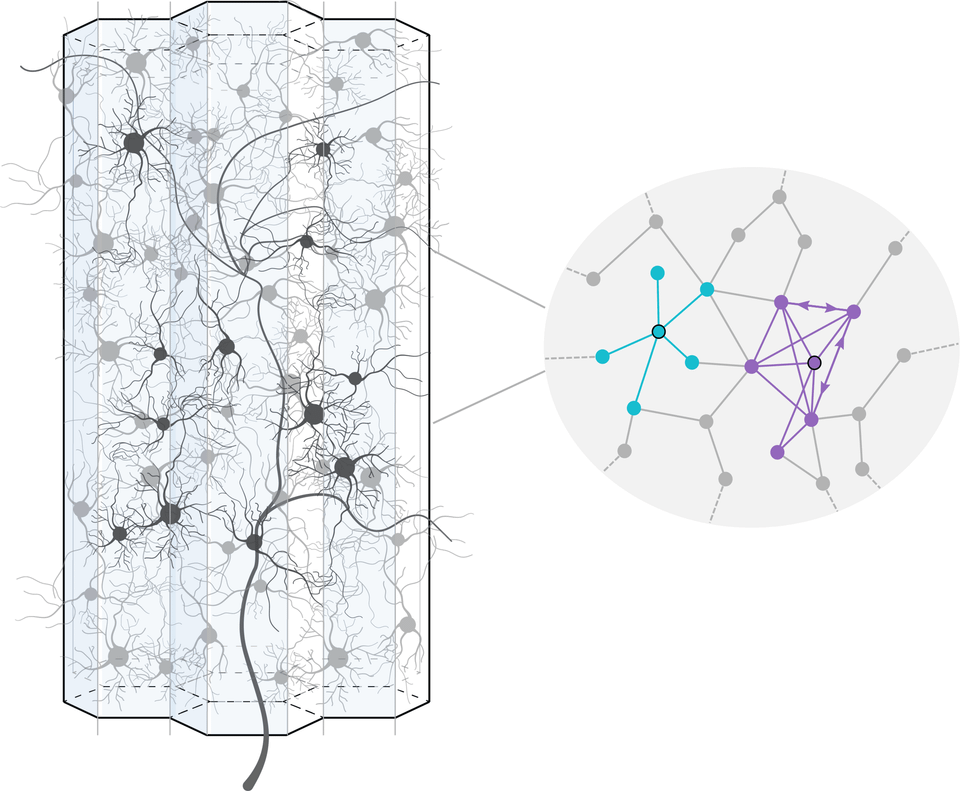
Abstract: A strong hypothesis in neuroscience is that many aspects of brain function are determined by the "map of the brain" and that its computational power relies on its connectivity architecture. Impressive scientific and engineering advances in recent years have generated a plethora of large-scale, cellular-resolution brain network reconstructions of incredibly complex architectures. A central feature of this architecture is its inherent directionality, which reflects the flow of information. Evidence shows that reciprocal connections and higher-order motifs, such as directed cliques, emerge preferentially rather than at random in biological neural networks. This raises fundamental questions in both mathematics and computational neuroscience. In this talk, we first examine the presence and functional relevance of these connectivity patterns and how they naturally emerge from the physical constraints of neuronal morphology. We then distill the underlying mechanism into a point-neuron stochastic algorithm that reproduces both the basic network statistics and the higher-order structure observed in biology. Finally, we discuss ongoing work on higher-order generalizations of the rich-club phenomenon, exploring how neurons that participate in cliques preferentially connect to one another through cliques in a directed sense.
Organiser: Renee Hoekzema