Cobordism of nested manifolds
By Alba Sendón Blanco
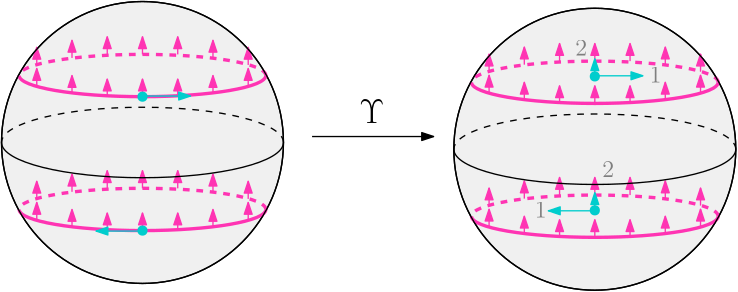
Imagine that you have a nested manifold: a small manifold inside a big manifold. You know that the big manifold is a boundary and that the small manifold is a boundary. With this information, when can you assert that your nested manifold is a nested boundary?Wall already knew that stably, the answer to this question is "always". This document delves further in this problem via a nested Pontryagin-Thom construction: the study of nested manifolds up to cobordism amounts to the study of the homotopy groups of... bananas! As a consequence, we give an alternative proof of Wall's result. Moreover, we conclude that the unstable answer to the above question is "not always". Particularly, when our big manifold has a trivial normal direction, we can move the small manifold apart from the big manifold along this direction (as in the picture), hence turning our nested manifold into two disjoint manifolds, i.e. a link. This gives interesting nested cobordism invariants coming from cobordism invariants for links.
See the full preprint below
 Alba Sendón Blanco