A network based circuit model approach to understand thermal transport mechanisms
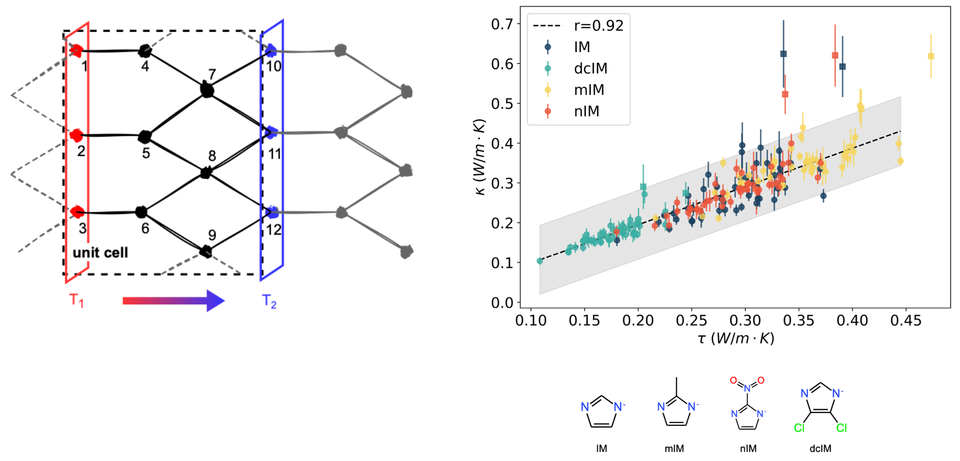
Zeolitic imidazolate frameworks (ZIFs), a subclass of metal-organic frameworks (MOFs), exhibit tunable thermal conductivity, which is crucial for applications such as gas adsorption, catalysis, and energy storage. Despite its significance, thermal conductivity in MOFs remains less explored compared to other key performance indicators. In this work, CTA^2 member Senja Barthel and collaborators at EPFL (Switzerland) and NTNU (Norway) investigated the thermal transport properties of 196 ZIF structures with diverse net topologies and organic linkers. The authors developed a thermal circuit model that quantitatively integrates network topology and consolidates various atomic contributions into heat conduction units for thermal analysis. The results reveal a strong correlation between circuit-estimated and simulated thermal conductivity, demonstrating the model’s predictive power. Additionally, it is found that functional groups influence thermal transport through a competing interplay between atomic mass and mechanical stability. These insights provide a systematic approach for tailoring MOF thermal properties, offering insights into the rational design of materials with optimized thermal performance.
Published paper:
